
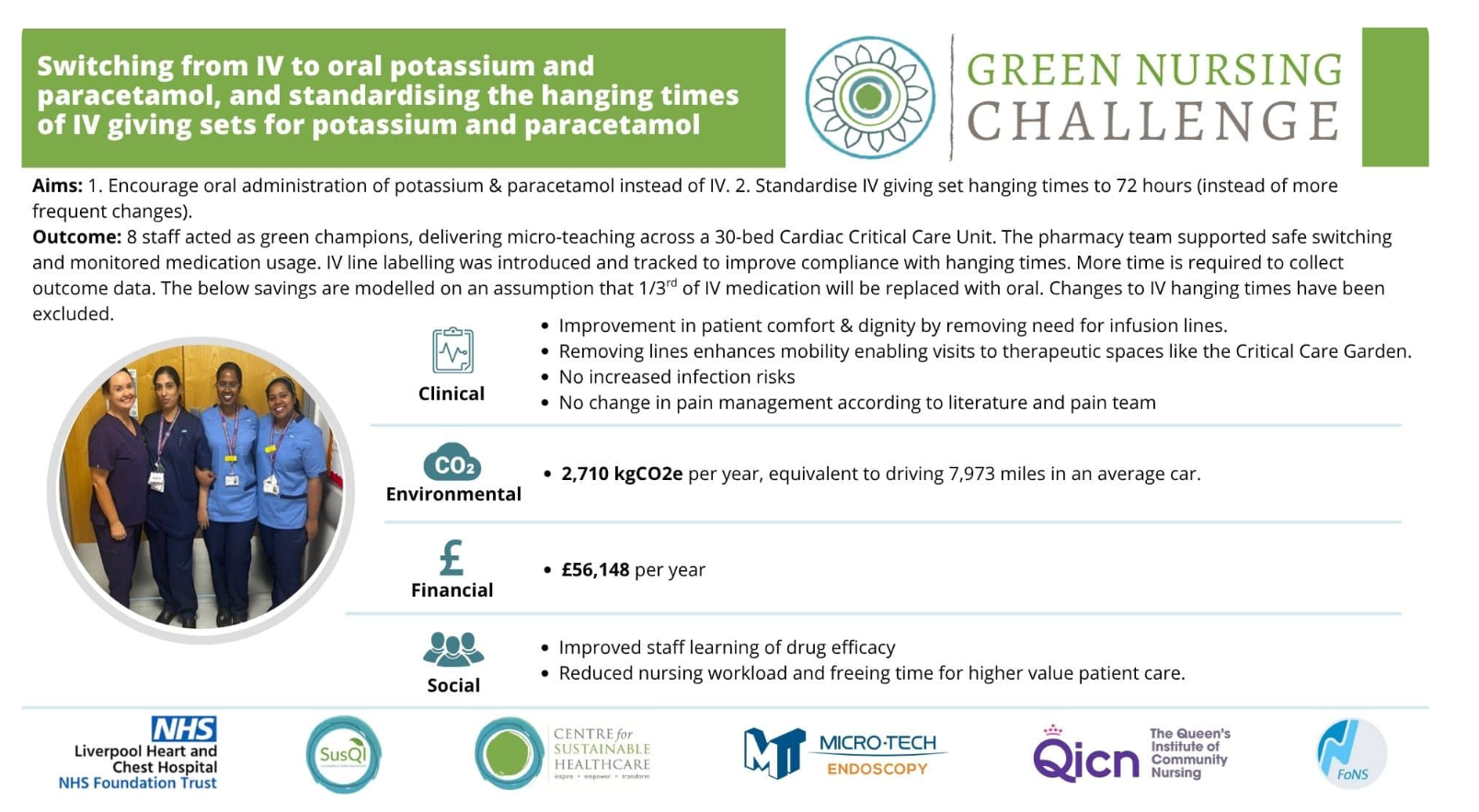
Project completed as part of the National 2025 Green Nursing Challenge by Liverpool Heart and Chest NHS Foundation Trust
Issue:
The cardiac Critical Care Unit at the Liverpool Heart and Chest Hospital is a busy 30 bedded unit with high medication use. The use of IV medication and subsequently IV giving sets on the unit, is high.
Medications were often prescribed to be given via either the IV or oral route. Electronic prescribing records were used where a nurse selected the administration route of a medication. There were no guidelines to help nurses choose the most appropriate route of administration routes, therefore practice amongst nursing staff varied. It was understood that the IV route was used in the majority of cases. Medication given via the oral route, when clinically appropriate, is the preferred route due to reduced costs, infection risks , and time. Medications given orally have a lower carbon footprint. Misconceptions regarding the efficacy of IV paracetamol existed amongst the clinical staff.
The hanging times for giving sets varied on the unit and lines were not routinely labelled to outline expiry dates - therefore line-change practice varied.
Intervention:
The team set about trying to encourage the administration of potassium and paracetamol using the enteral route in place when clinically appropriate, and standardising the hanging times of IV giving sets to 72 hours. Supported by pharmacy colleagues, they set up micro-teaching sessions to ensure switches were clinically appropriate, safe & effective. They sought advice from their Pain team colleagues.
A Poster was designed to prompt staff to consider the changes and use of line labels
Outcomes:
Clinical :
IV medications continue to be used when clinically indicated.
Switching from IV to oral medications in critical care settings can significantly enhance patient comfort, independence, mobility and dignity by removing the need for infusion lines or syringe drivers. Trips to the ambulance bay were popular with long-term patients (family members bring along patients’ pets - bringing boosts to patient morale and reduction in anxiety. Improved mobility supports earlier and more effective rehabilitation, which can lead to quicker, safer discharges and reduced length of stay in critical care.
Minimising line manipulation through our second change to extend the life of hanging times may improve patient comfort and reduce risks such as phlebitis, fluid overload and medication errors. Research shows there is no increase in infection risk associated with longer hanging times.
Environmental:
Assuming that a third of IV bags could be switched to tablets, savings of 97.3 kgCO2efor Potassium and 128.6 kgCO2e per month could be achieved. Extrapolated to a year, switching from IV to oral would lead to GHG emissions savings of 1,167 kgCO2e for Potassium and 1,543 kgCO2e for Paracetamol. This is a total saving of 2,710 kgCO2e, equivalent to driving 7,973 miles in an average car.
Unfortunately data was unavailable regarding the line changes part of the project therefore excluded in the final reporting to date. The team plan to continue the project and collect data in the near future.
Economical
Assuming that a third of IV bags could be switched to tablets, they team were able to extrapolate the following costings.
Paracetamol:
IV cost: £1,074.97/month
Oral cost (2 tablets per dose): £741.43/month
Monthly savings: £333.53
Potassium:
IV cost: £11,162.30/month
Oral cost (4 tablets per dose): £7,679.45/month
Monthly savings: £3,482.85
Additional savings from reduced use of giving sets: £1,196.15/month. Total projected annual savings: £56,148.
Social
Staff reported that administering IV medications is significantly more resource-intensive than oral alternatives, involving multiple steps such as drug preparation, double-checking procedures, documentation, flushing lines, and safe disposal of packaging and sharps. This process increases workload and reduces time available for direct patient care. IV administration is often chosen out of habit or perceived efficacy, despite limited line access and time constraints.
Unfortunately the data was unavailable to measure the impact of extending hanging times. This is something that the team wish to continue to promote and plan to collate this data in the future. The team plans to review the practice of line removal (for around 2,200 patients per year). The hope is that where the enteral route is embedded in staff behaviours, there may be scope to remove IV lines sooner and further progress could take place exploring other themes around patient safety and improvement.
Key Learning
To ensure lasting change, the team have taken additional steps to revise the prescribing border set - after 24 hrs, oral medication will appear as the only route prescribed.
.
 Download resource -
Please log in or sign up to comment.