
This project was completed as part of the 2026 Hampshire Hospitals NHS FT Green Team Competition.
Team members
- Kemi Adegboyega, Matron
- Cheryl Gadsby, Sister
Setting / patient group
This project was undertaken within the Heart Centre Catheterisation Laboratories (Cath Labs) at Hampshire Hospitals NHS Foundation Trust. The project focused on patients undergoing cardiology catheterisation and electrophysiology (EP) procedures, which require the routine use of surgical gowns, surgical hats and procedure packs.
Issue
The Heart Centre is a resource-intensive clinical environment with high consumption of single-use gowns, hats and procedure packs. EP procedures were being undertaken using angiography packs that contained items not required, including manifolds and gowns, while additional equipment had to be opened separately. This resulted in avoidable waste, increased preparation requirements and unnecessary use of resources.
Intervention
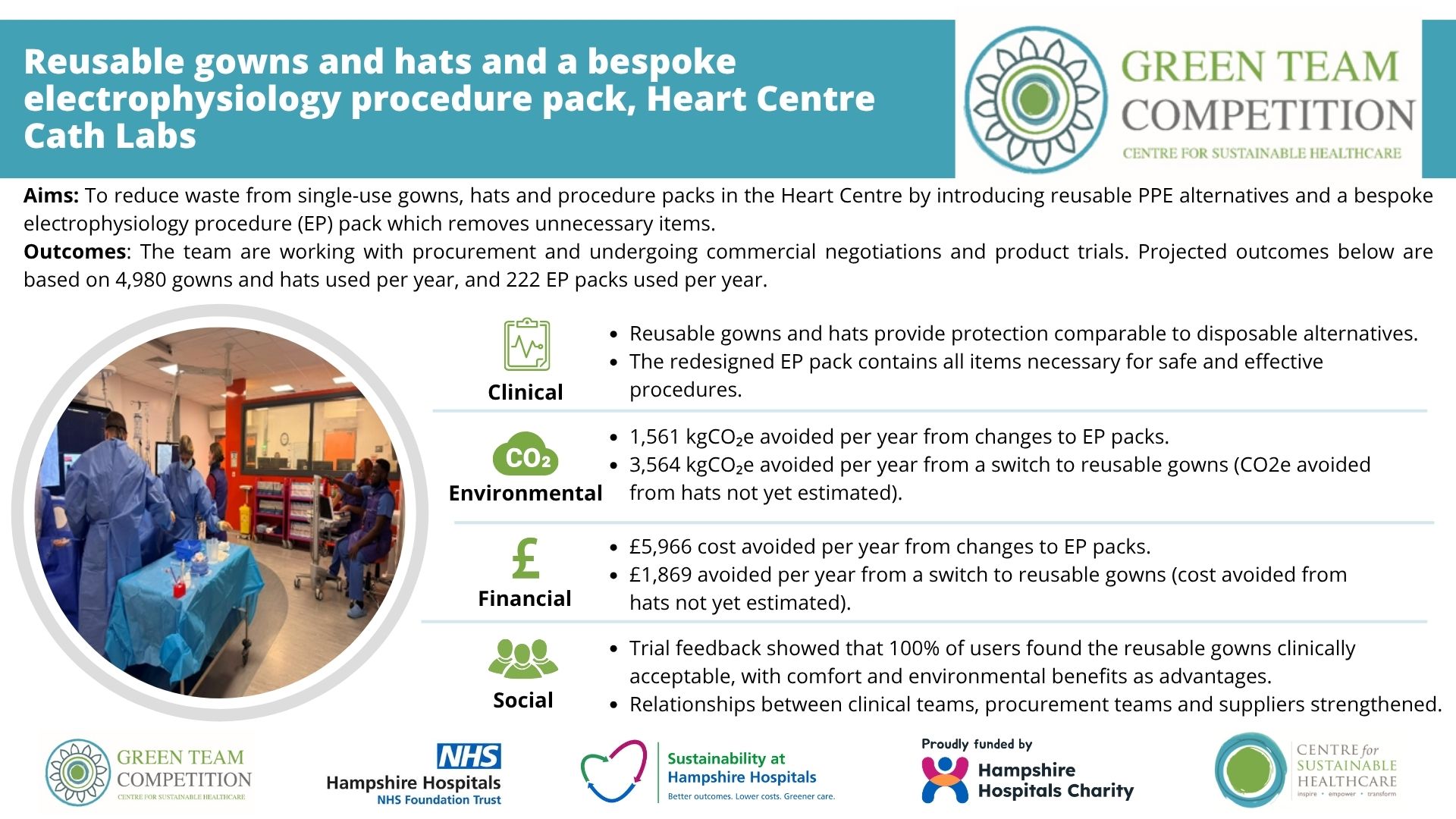
The project proposed three changes: replacing disposable surgical gowns with reusable gowns supplied by Elis, replacing disposable surgical hats with reusable alternatives supplied by Medicus, and introducing a bespoke EP procedure pack supplied by Mölnlycke. The new EP pack was designed specifically for electrophysiology procedures, removing unnecessary items from the existing angiography pack while including items that previously had to be added separately. Although none of the interventions had been fully implemented at the time of reporting because of procurement and commercial negotiations, product trials, stakeholder engagement and modelling of projected impacts were completed.
Potential Outcomes
Clinical
No adverse events were identified during product trials, and no negative patient outcomes are anticipated from any of the proposed changes. The literature review undertaken by the team found that reusable gowns provide protection comparable to disposable alternatives and that reusable surgical hats do not adversely affect patient safety. Trial feedback showed that 100% of users found the reusable gowns clinically acceptable.
Environmental
The proposed bespoke EP pack would reduce emissions by 1,561 kgCO₂e per year (based on 222 procedures annually).
Replacing disposable gowns with reusable gowns is projected to reduce annual emissions by 3,564 kgCO₂e. The introduction of reusable hats would prevent approximately 4,980 disposable hats entering the waste stream annually.
Financial
The bespoke EP pack is projected to reduce annual expenditure from £81,563 to £75,597, generating annual savings of £5,966. For gowns, annual expenditure would reduce from £9,730 for disposable gowns to £8,567 for reusable gowns, generating procurement savings of £1,163 per year. A further £707 in waste disposal savings is projected, giving total annual savings of £7,865 £1,869.29. Annual expenditure on disposable hats was £630.20, providing a baseline for future savings following implementation of reusable alternatives.
Social
Following improved staff engagement and education, feedback on reusable gowns was largely positive. Staff identified comfort and environmental benefits as advantages, and all respondents considered the gowns clinically acceptable. The reusable hat initiative generated considerable discussion about sustainability within the department, contributing positively to staff morale and encouraging further consideration of sustainable practice. Engagement with clinical teams, procurement teams and suppliers also helped build support for the proposed changes.
Key learning point
The project highlighted that implementing sustainable change in healthcare is often a complex and time-consuming process that requires collaboration between clinical teams, procurement services and external suppliers. Early stakeholder engagement, clear communication and organisational support were identified as essential factors in overcoming barriers and successfully delivering sustainable practice change. The team reflected that future projects would benefit from more time spent engaging and building relationships with key stakeholders at an earlier stage to help accelerate implementation.
 Download resource -
Please log in or sign up to comment.