
Project completed as part of the Wrightington, Wigan and Leigh (WWL) Green Team Competition 2025.
Team members
- Lewis Veale, Physician Associate & Skin Cancer Pathway Specialist, Wrightington, Wigan and Leigh Teaching Hospitals NHS FT.
- Dr Monica Bhushan, Consultant Dermatologist & Clinical Lead for Skin Cancer, Wrightington, Wigan and Leigh Teaching Hospitals NHS FT.
- Andrea Jones, Head of Medical Illustration, Wrightington, Wigan and Leigh Teaching Hospitals NHS FT.
- Olivia Madden, Medical Photographer, Wrightington, Wigan and Leigh Teaching Hospitals NHS FT.
- Ayesha Habib, MBChB Student (Year 4), Edge Hill University
Setting
The Urgent Suspected Skin Cancer (USSC) Teledermatology pathway at Wrightington, Wigan and Leigh Teaching Hospitals NHS Foundation Trust, serving a population of approximately 326,000 people across the Wigan borough.
Issue
Demand for the USSC pathway is increasing rapidly, with referrals rising by around 15% in 2024-25 and the service expected to receive close to 5,000 referrals annually. Under the Teledermatology model, patients attend medical photography appointments before images and questionnaires are reviewed remotely by dermatologists. Although this model doubles review capacity compared with traditional face-to-face clinics, all patients were required to travel to Leigh Infirmary, often for a 10 to 15 minute appointment. Patients frequently reported challenges relating to travel distance, traffic, parking and accessibility.
Intervention
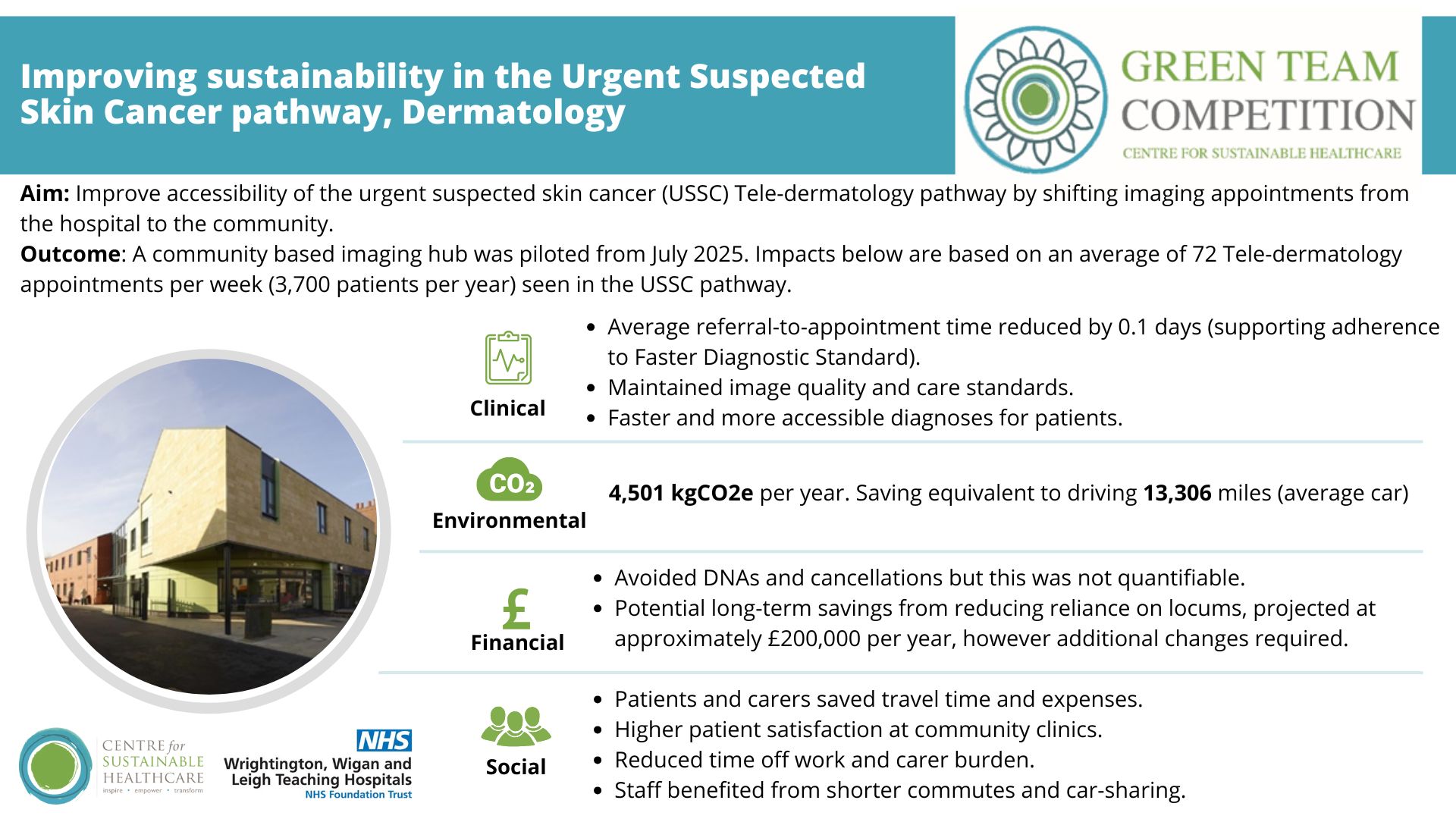
The team reviewed the entire USSC pathway and identified reducing patient travel and improving accessibility as the most feasible and impactful sustainability opportunity. Working with estates, medical illustration and operational teams, they developed a community imaging hub model, moving the first point of contact for Teledermatology closer to patients' homes.
Analysis of referral postcode data identified WN2, WN6 and WN7 as the most common patient locations. Following site assessments, Standish Clinic was selected for an initial 6 to 8 week pilot, with plans for a second community imaging hub at Boston House. Patients from selected postcodes were offered the option to attend the community clinic when booking. The intervention utilised existing WWL facilities and portable photography equipment, requiring no additional estate or staffing costs.
Outcomes
Clinical:
- Patients attending Standish Clinic were seen slightly sooner, with an average of 7.5 days from GP referral to first appointment compared with 7.6 days at Leigh Infirmary.
- Community clinics maintained standards of care and image quality, with no adverse impact identified.
Environmental:
- Annual carbon savings were projected at approximately 4,501 kgCO2e if the service operates at full planned capacity.
- Average patient travel distance reduced by one-third and travel related emissions reduced by 41% per appointment
The proportion of patients walking to appointments increased from 7% to 15%.
Financial:
- The project was implemented with no additional estate, equipment or staffing costs.
- Improved accessibility is expected to support uptake of the Teledermatology model, which helps avoid up to six locum-led suspected cancer clinics per week.
- The Teledermatology pathway is estimated to reduce locum costs by up to £199,680 per year when operating at planned capacity.
Social:
- Community clinics reduced travel burden for patients, carers and families and may reduce time away from work, school and caring responsibilities.
- Patient satisfaction was high at both sites, with slightly higher overall satisfaction scores at Standish.
- Patients highlighted the convenience of being able to attend a clinic closer to home, with comments including “Much better to come here. Very close to home” and “Being able to attend Standish rather than Leigh was a massive help.”
- Staff reported positive experiences, including opportunities for car sharing and strong patient support for the change.
Key learning point
Moving diagnostic and assessment services closer to patients can significantly reduce travel-related carbon emissions while improving accessibility and maintaining clinical quality. Using existing community facilities and portable equipment enabled a low-cost intervention that delivered environmental, social and service benefits, while supporting the long-term sustainability of the Teledermatology pathway.
 Download resource -
Please log in or sign up to comment.