
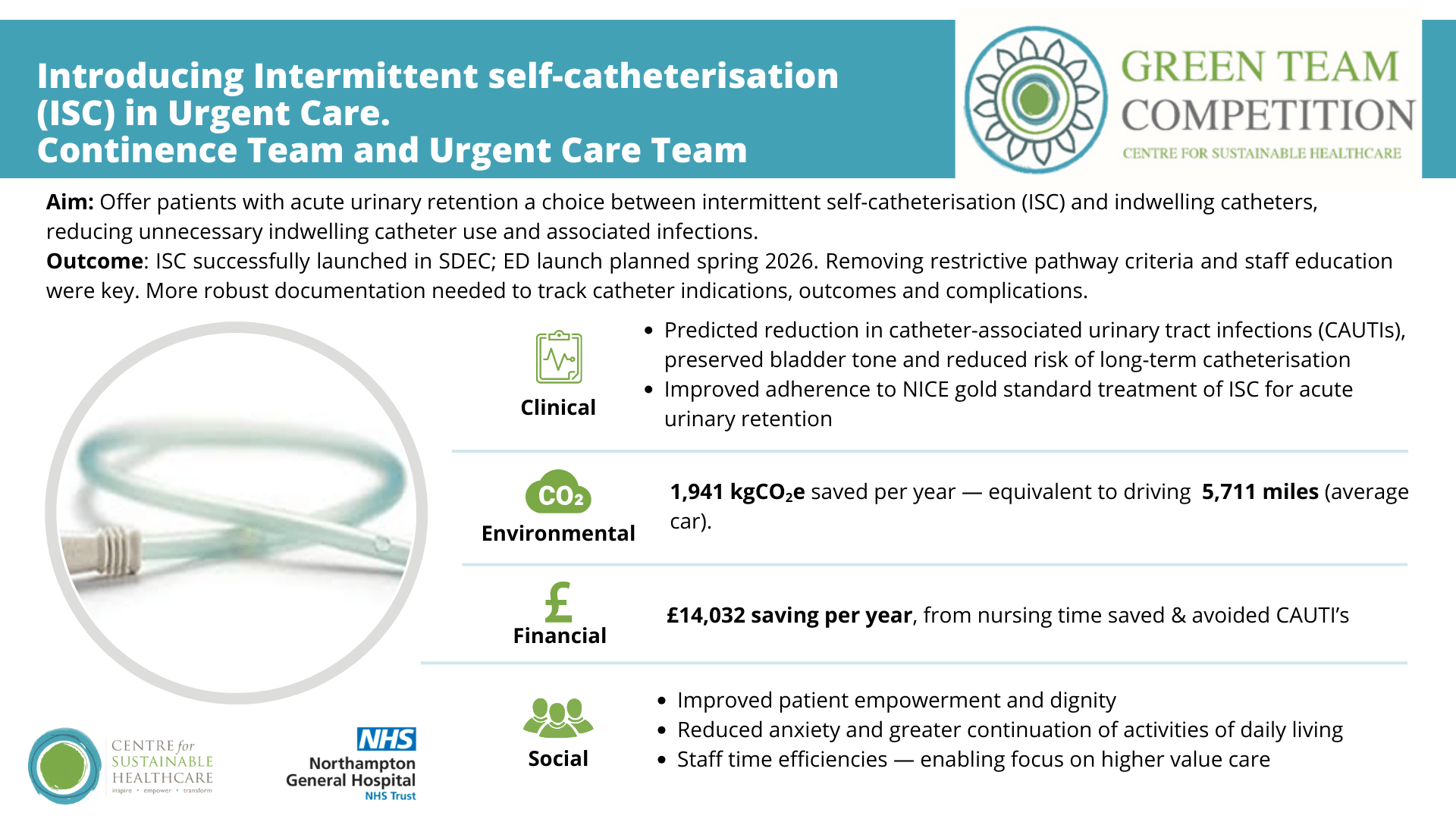
Project completed as part of the University Hospitals of Northampton Green Team Competition.
Team members
Claire Morton, continence nurse specialist.
Setting / patent group:
Urgent Care
Issue:
Indwelling catheterisation was the default intervention in Urgent Care for acute urinary retention. It is associated with increased risk of catheter‑associated urinary tract infections (CAUTIs), repeat attendances, reduced bladder tone and patient distress, as well as avoidable financial and carbon costs. Long waits for trial without catheter (TWOC) and frequent catheter‑related complications added pressure across Urgent Care, urology and community nursing. Limited training and restrictive exclusion criteria meant no patients were being offered intermittent self‑catheterisation (ISC), despite NICE recognition as the gold standard for bladder drainage.
Intervention:
The team introduced a choice of ISC versus indwelling catheter for clinically appropriate patients with acute urinary retention in Urgent Care/SDEC. The ISC pathway was revised, and exclusion criteria broaden to increase eligibility. A nurse‑led pathway was devised and staff training was provided. ISC was launched in SDEC and will go live in ED post‑winter pressures. Patient education focused on aseptic technique and self‑management, while operational changes targeted faster decision‑making, reduced unnecessary catheterisation and complications.
Outcomes:
Clinical
A 20% swap from in-dwelling catheters to the NICE gold standard of ISC in Urgent Care was modelled. It is predicted to reduce CAUTIs, preserve bladder tone and reduce the risk of long-term catheterisation. A conservative model predicts at least 2 fewer CAUTIs per year, alongside fewer catheter related‑related re‑attendances.
Environmental
Lifecycle modelling indicated the carbon emissions associated from insertion and home consumables for 30-days, could be reduced by 5.52 kgCO2e (63%) per episode of care. A 20% adoption rate modelled a saving of 917.8 kgCO₂e per year. Further modelling to include avoidance of secondary infection treatment, demonstrated a combined yearly saving of 1,941.1 kgCO₂e. This is the equivalent of driving 5,711 miles in an average car of unknown fuel.
Financial
Whilst the financial cost for insertion consumables is almost cost-neutral, there would be a yearly rise of £3688 when including the cost of home supplies. This is almost offset by a yearly modelled saving from staff time efficiencies of £3180 (60-hours). When a cautious projection of two avoided CAUTI’s per year are included, a financial saving of £14,032 per year is predicted.
Social
ISC promotes independence and dignity, reduces anxiety, and allows greater continuation of activities of daily living, whilst encouraging patient empowerment. Fewer complication related‑related hospital visits, reduced disruption for patients and carers and staff time efficiencies are predicted.
Key learning point
Removal of restrictive pathway criteria and targeted staff education, with supplier support, were key to the project success. Robust documentation and better data flows are needed to track catheter indications, outcomes and complications. This approach is low cost, scalable‑cost, scalable and transferable across Urgent Care and inpatient settings.
 Download resource -
Please log in or sign up to comment.