
This project was undertaken at Hospital Universitario Fundación Jiménez Díaz as part of the KitNewCare project.
Team members
Alberto Ortiz Arduan: Head of the Nephrology Service
Marina González de Rivera Utrera: Nephrologist
Alejandro Avello Escribano: Nephrologist
Lucía García Cordero Galán: Nephrologist
Rodrigo Martínez Cadenas: Bioinformatician and PhD candidate
Blanca Tarragón Estébanez: Consultant Nephrologist and Researcher
Mónica Pereira: Nursing Supervisor
Setting/ patient group
The intervention was implemented in the haemodialysis unit of a university hospital participating in the KitNewCare project. The unit routinely manages patients with diabetes who require regular glucose monitoring as part of their care.
A subset of patients already using continuous glucose monitoring devices, providing an opportunity to assess whether routine capillary testing can be reduced.
Issue
In the haemodialysis unit, routine practice includes performing capillary glucose measurements in all diabetic patients at the start of each session, regardless of whether patients are already using continuous glucose monitoring devices.
This results in unnecessary use of disposable glucose strip tests and consumables including gloves and needles used by nurses to carry out the tests.
Intervention
Training was given to staff to explain why the change was being introduced and update to workflow to check and record glucose levels using patient CGM devices.
Seven haemodialysis patients using CGM devices were identified for implementation of the optimised approach. The change to practice was explained to these patients and reassurance given that duplicate measurements are not clinically necessary.
Previously, capillary glucose measurements were performed routinely at the start of each dialysis session. Following optimisation, testing was limited to cases where clinically indicated, with reliance on CGM data for routine monitoring.
Outcomes
Patient Outcomes
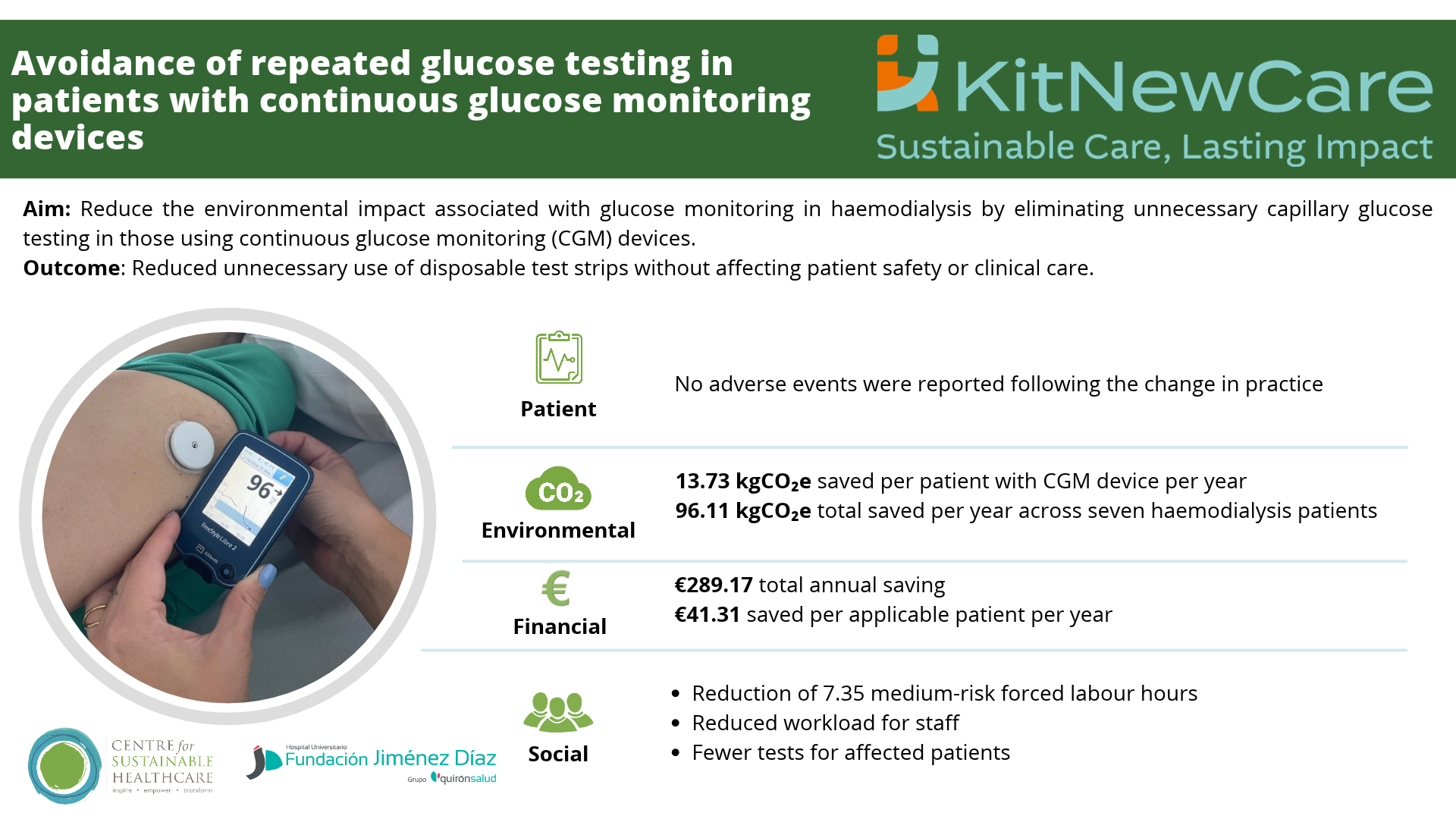
No adverse events were reported following the change in practice.
Environmental
The estimated carbon footprint per test is 0.088 kgCO₂e, incorporating all components. This consists of glucose test strips (0.023 kgCO₂e), gloves (0.043 kgCO₂e), and a 5 mL syringe (0.022 kgCO₂e), with gloves representing the largest contribution.
Based on three haemodialysis sessions per week (156 tests annually), discontinuation of testing would result in an estimated saving of 13.73 kgCO₂e per patient per year. For the seven patients affected, this equates to a total annual saving of 96.11 kgCO₂e.
Economic
The lowest available cost of a strip test on the market was €0.1848 per test strip when procured in bulk, with additional consumable costs of an estimated €0.05 for gloves (one pair) and €0.03 for a 5 mL syringe, giving a total cost of €0.2648 per test. Across 156 haemodialysis sessions per patient annually, discontinuation of testing results in a saving of €41.31 per patient per year. For the seven patients affected, this corresponds to a total annual saving of €289.17.
Social
The intervention resulted in a reduction of an estimated 7.35 forced labour medium risk hours, associated with decreased demand for raw materials used in the production of glucose test strips, particularly silver.
For staff there is a modest reduction in workload from the discontinuation of unnecessary glucose testing. From a patient comfort perspective, patients undergo less testing.
Summary
The intervention demonstrates how aligning clinical practice with available monitoring technologies can improve sustainability without compromising patient outcomes, particularly in settings where routine practices have not yet adapted to technological advances.
This approach can be applied to other kidney centres and healthcare settings where patients have monitoring devices. Higher savings would be observed in centres and settings with more patients using continuous monitoring devices.
 Download resource -
great work, team!
Please log in or sign up to comment.