
This project was undertaken at Warszawski Uniwersytet Medyczny Hospital as part of the KitNewCare project.
Team members
Zuzanna Jakubowska1
Małgorzata Kępska Dzilińska1
Ewa Wojtaszek1
Jolanta Małyszko1
Paweł Żebrowski1
Urszula Jabłońska2
Jarosław Gopek3
1 physician, nephrologist
2 nurse
3 administrative worker / finance professional
Setting/ patient group
The optimization was implemented in the dialysis unit of a university hospital, which provides care for approximately 90 patients on chronic hemodialysis.
Issue
In the dialysis unit, monthly laboratory panels included both mandatory tests (as required by the national healthcare fund) and a range of additional analyses. Several of these tests are of limited or no clinical value when performed routinely in stable dialysis patients. This led to redundant investigations, unnecessary blood draws, and increased laboratory workload.
Intervention
The intervention involved a structured review of routine laboratory testing within the dialysis unit. Existing test panels were assessed to identify low-value or redundant investigations, with proposed changes reviewed for clinical safety and feasibility. Electronic laboratory panels were then updated to remove unnecessary tests, and the changes were communicated to medical staff. Laboratory test ordering and blood collection tube use were subsequently monitored, alongside staff feedback, to support sustained implementation and identify any further improvements.
Outcomes
Patient
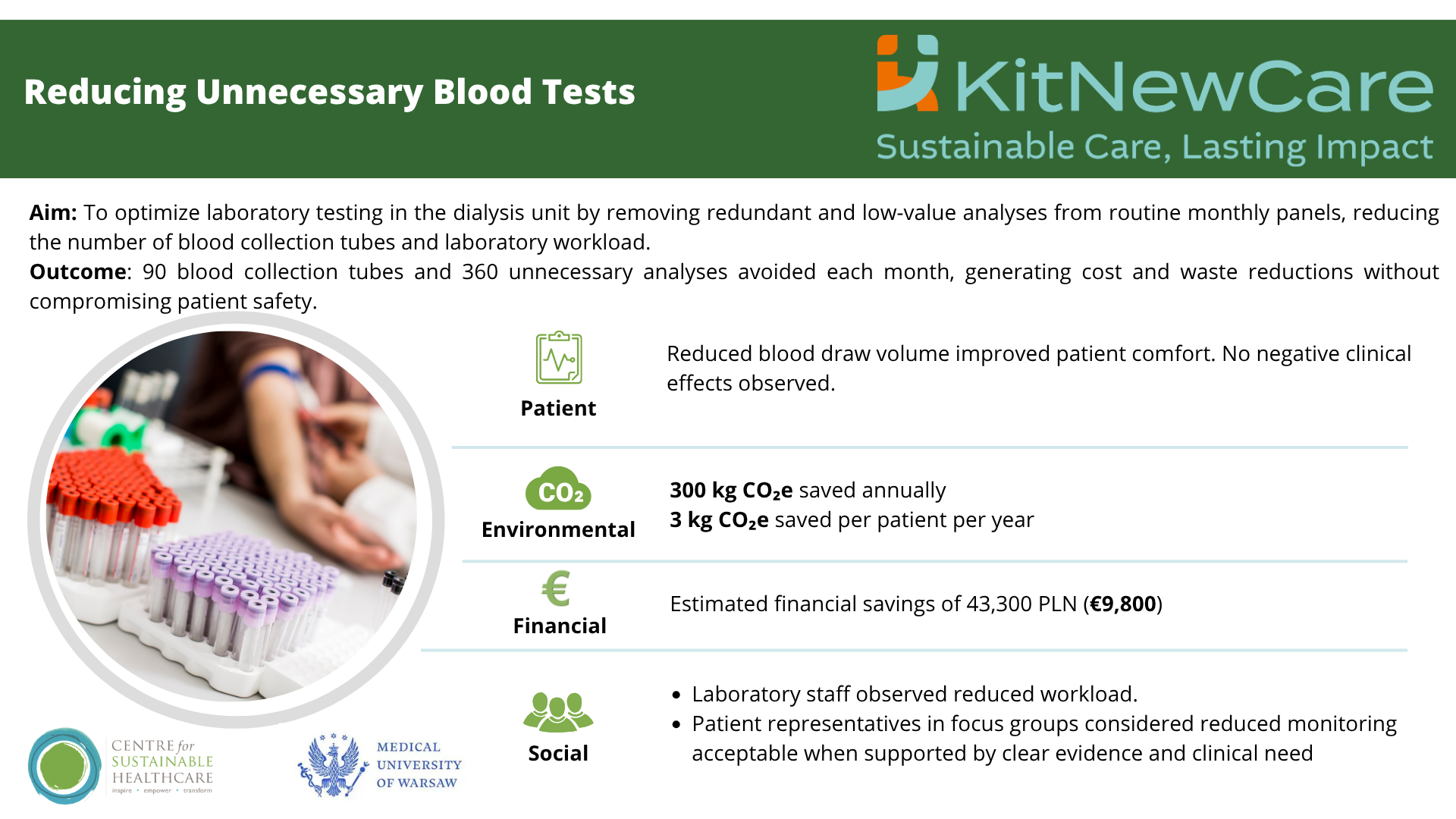
Blood draws decreased by one tube per patient per month. Reduced blood draw volume improved patient comfort. No negative clinical effects observed.
Environmental
Based on published estimates for laboratory consumables and testing, the intervention was associated with an estimated reduction of approximately 250-350 kg CO₂e annually (around 3 kg CO₂e per patient per year).
Economic
Savings from reduced analyses are estimated at approximately 2,800 to 4,100 PLN per month (equivalent to €640 to €940 per month), based on a reduction of around 360 tests and typical unit costs. This corresponds to an estimated 34,000 to 49,000 PLN annually (equivalent to €7,800 to €11,300 per year).
Additional savings were achieved through reduced use of blood collection tubes, estimated at approximately 1,080 PLN per year (equivalent to €250 per year).
Social
Laboratory staff observed reduced workload. Increased staff awareness of evidence-based testing and sustainable practice.
Focus group participants highlighted the importance of clear communication and evidence when reducing routine testing.
Summary
Removing low-value tests from the monthly panel reduced blood tubes, prevented 360 unnecessary tests/month, and generated meaningful cost and waste reductions - all without compromising patient safety.
 Download resource -
Please log in or sign up to comment.