
This project was undertaken at Warszawski Uniwersytet Medyczny Hospital as part of the KitNewCare project.
Team members
Zuzanna Jakubowska1
Małgorzata Kępska Dzilińska1
Ewa Wojtaszek1
Jolanta Małyszko1
Paweł Żebrowski1
Urszula Jabłońska2
Jarosław Gopek3
1 physician, nephrologist
2 nurse
3 administrative worker / finance professional
Setting/ patient group
The optimization initiative for reducing drug returns was initially introduced within the Nephrology Department, which serves approximately 1,000 patient-days per month. This setting provided an ideal environment to test and refine the integrated online ordering and pharmacy system due to its high volume and the critical nature of medication management.
Issue
The hospital faces significant challenges with the high volume of drug returns due to expired medications. Prior to the intervention, medications that were used infrequently or prescribed on a case-by-case basis were routinely stocked on wards. Due to limited visibility of usage patterns and expiry dates, these items were often ordered in standard quantities and retained in ward stock, even when demand was low.
Intervention
This change project involved two complementary components: technical system integration and behavioural interventions through training.
Technical integration: The online medical ordering system was synchronized with the pharmacy’s inventory software to enable real-time stock updates, improved demand forecasting, and notifications regarding medication expiry dates.
Process redesign: Existing ordering and returns workflows were redesigned to reduce inefficiencies and miscommunication. This included the introduction of automated alerts for near-expiry medications and streamlined processes for returning unused stock.
Further details of the implementation process can be found in the full case study.
Outcomes
Patient
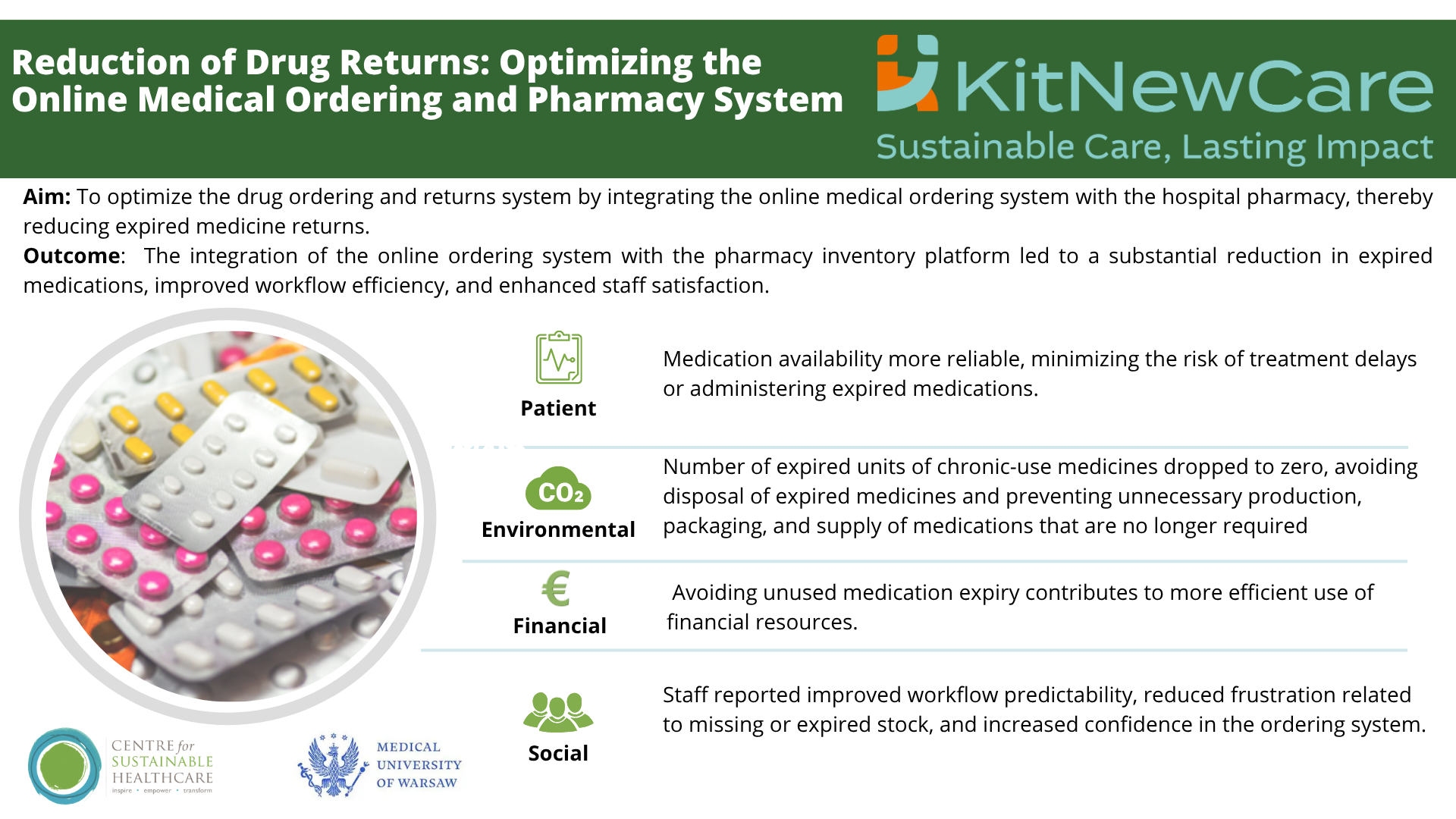
Key medications no longer expired on the ward. As a result, medication availability was more reliable, minimizing the risk of treatment delays or administering expired medications.
Environmental
Before integration, expired medication returns represented a recurring waste stream. After implementation, the number of expired units of chronic-use medicines dropped to zero. While the exact volume of avoided waste could not be quantified, this reduction is expected to decrease environmental impact not only by avoiding disposal of expired medicines but also by preventing unnecessary production, packaging, and supply of medications that are no longer required.
Economic
The reduction in expired medications led to avoided financial losses associated with unused stock. Previously, expired medications represented preventable waste within the pharmacy budget.
Social
Staff reported improved workflow predictability, reduced frustration related to missing or expired stock, and increased confidence in the ordering system.
Summary
The integration of the online ordering system with the pharmacy inventory platform led to a reduction in expired medications, improved workflow efficiency, and enhanced staff satisfaction.
Key contributors to success included:
•Consistent leadership support for IT integration,
•Structured staff training and engagement,
•Clear communication channels between pharmacy and clinical staff,
•Automated alerts and real-time stock visibility.
 Download resource -
Please log in or sign up to comment.