
This project was undertaken at Warszawski Uniwersytet Medyczny Hospital as part of the KitNewCare project.
Team members
Zuzanna Jakubowska1
Małgorzata Kępska Dzilińska1
Ewa Wojtaszek1
Jolanta Małyszko1
Paweł Żebrowski1
Urszula Jabłońska2
Jarosław Gopek3
1 physician, nephrologist
2 nurse
3 administrative worker / finance professional
Life Cycle Assessment Support
Life Cycle Assessments were conducted by Abass Fehintola, PhD Candidate at Trinity College Dublin.
Setting/ patient group
The optimization was implemented in the dialysis unit of a university hospital, which provides care for approximately 90 patients on chronic hemodialysis. Following a recent renovation, the unit now has a dedicated drainage room designed to ensure safe handling of biohazard materials. This facility allows nurses and assistants to empty bloodlines and dialysate lines without risk to staff.
Issue
In the dialysis unit, used bloodlines and dialysate lines from hemodialysis sessions were discarded with residual blood and fluids inside. This practice significantly increases the weight of medical waste classified as infectious, which must then be incinerated. Heavier waste bags result in higher waste management costs and a greater environmental footprint.
Intervention
The intervention introduced a standardised process for draining bloodlines and dialysate lines before disposal. A standard operating procedure was developed, and nursing staff and dialysis assistants received training on the new process, with a focus on safety and infection control. Drainage was carried out in a dedicated room using appropriate protective equipment, and the procedure was incorporated into routine practice. Waste generation was monitored before and after implementation to assess its impact, while staff feedback helped support ongoing adoption of the change.
Outcomes
Environmental
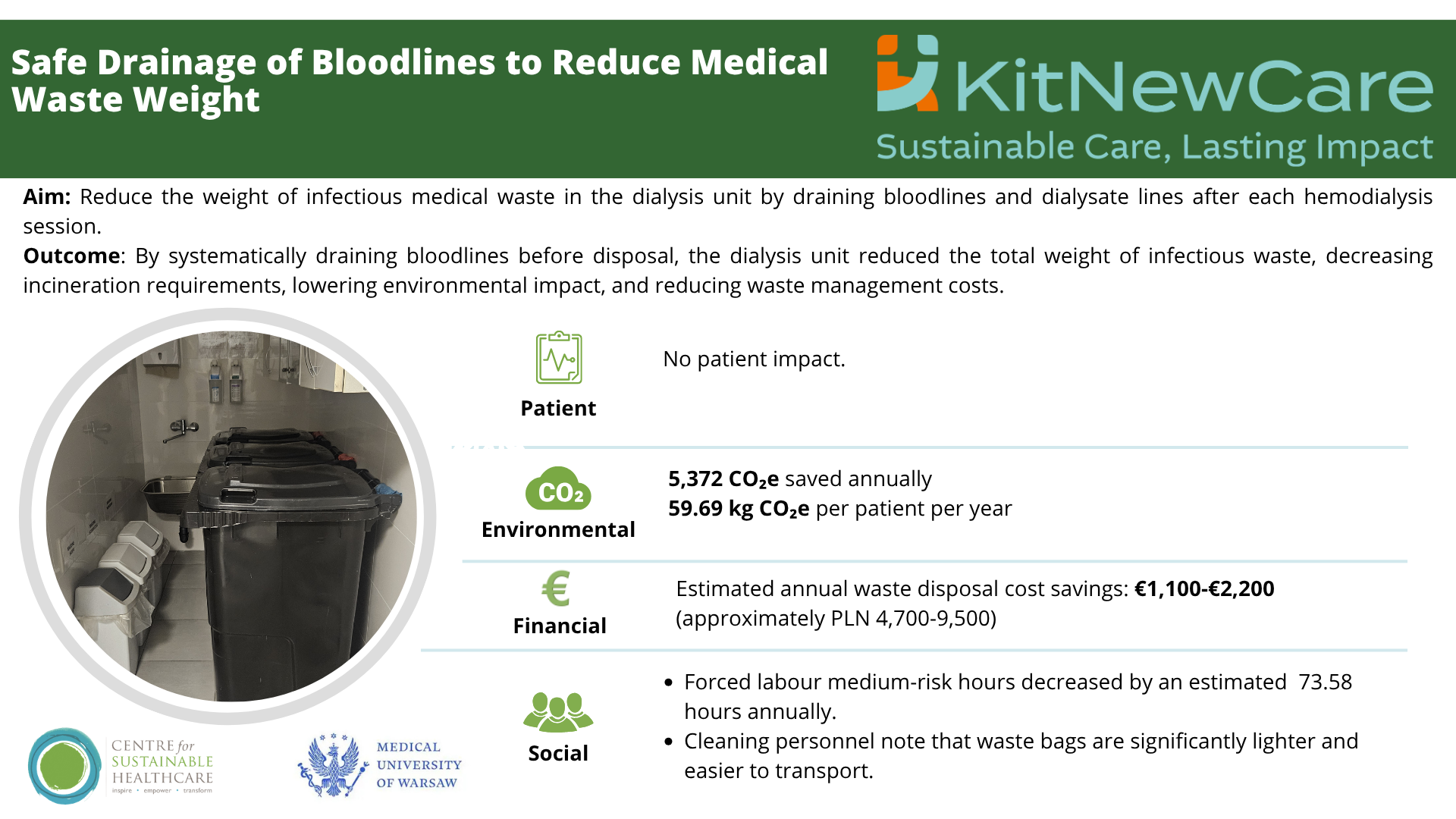
The intervention reduced infectious waste by an estimated 2.23 tonnes annually, with associated savings of approximately 5,372 kg CO₂e and 357.45 m³ water deprivation per year. This equates to around 24.8 kg less waste, 59.69 kg CO₂e savings, and 3.97 m³ water savings per haemodialysis patient annually.
Economic
The reduction in infectious waste is estimated to generate annual waste disposal cost savings of approximately €1,100-€2,200 (around PLN 4,700-9,500) depending on local disposal costs.
Social
Staff reported that the procedure was safe, practical, and easy to implement, while cleaning staff noted that waste bags were lighter and easier to handle. No infection control concerns were identified following implementation. The intervention was also associated with an estimated reduction of 73.58 forced labour medium-risk hours annually.
Summary
Safe drainage of bloodlines reduced infectious waste by 172 g per treatment, translating to 186 kg/month, and 2.23 tons per year. The intervention is environmentally impactful, cost-saving, and easy to sustain, with no effect on patient care.
Key success factors:
• dedicated drainage room,
• clear protocol and training,
• leadership support,
• strong staff adherence.
 Download resource -
Please log in or sign up to comment.