
This project was undertaken at Università degli Studi di Modena e Reggio Emilia (UNIMORE) Hospital as part of the KitNewCare project.
Team members
Gaetano Alfano: Nephrologist
Niccolò Morisi: Nephrologist
Giuseppe Di Chiaro: Nephrologist and PhD Student
Gabriele Donati: Head of Nephrology Department
Annarita Villani: Head of Dialysis Nurses
Rita Pecoraro: Dialysis Nurse
Giulia Ligabue: Biologist
Marco Ferrarini: Biotechnician
Silvia Giovanella: Biotechnician
Life Cycle Assessment Support
Life Cycle Assessments were conducted by Dr James Larkin, Postdoctoral Researcher and Sustainability Officer at Trinity College Dublin.
Setting/ patient group
This project took place in the Nephrology, Dialysis and Renal Transplant Department at a large tertiary centre managing a complex patient population across chronic and acute dialysis pathways. The centre provides approximately 40,000 haemodialysis treatments per year.
Multiple dialysis machine types are in use, contributing to variation in practice.
Dialysis machines used:
Fresenius 5008
Bellco Flexya
Nikkiso DBB-EXA
B. Braun Dialog iQ
Issue
Dialysis machines include functions such as standby mode, online priming and reinfusion, autoflow and dialyzer emptying that can reduce resource consumption and improve operational efficiency. However, these functions were used inconsistently across staff, shifts, and treatment areas, resulting in missed opportunities for sustainability and standardisation.
Intervention
A structured quality improvement project was undertaken to standardise dialysis machine practices and reduce unnecessary resource use. Baseline observations, staff questionnaires, and process mapping were used to identify variation in machine use, including priming and reinfusion practices. Findings informed staff engagement, training, and the implementation of more standardised approaches to dialysis machine operation. Ongoing feedback and monitoring supported adoption of consistent practices, including increased use of online priming and reinfusion in place of saline-based methods. Further details are provided in the accompanying PDF.
Outcomes
Environmental
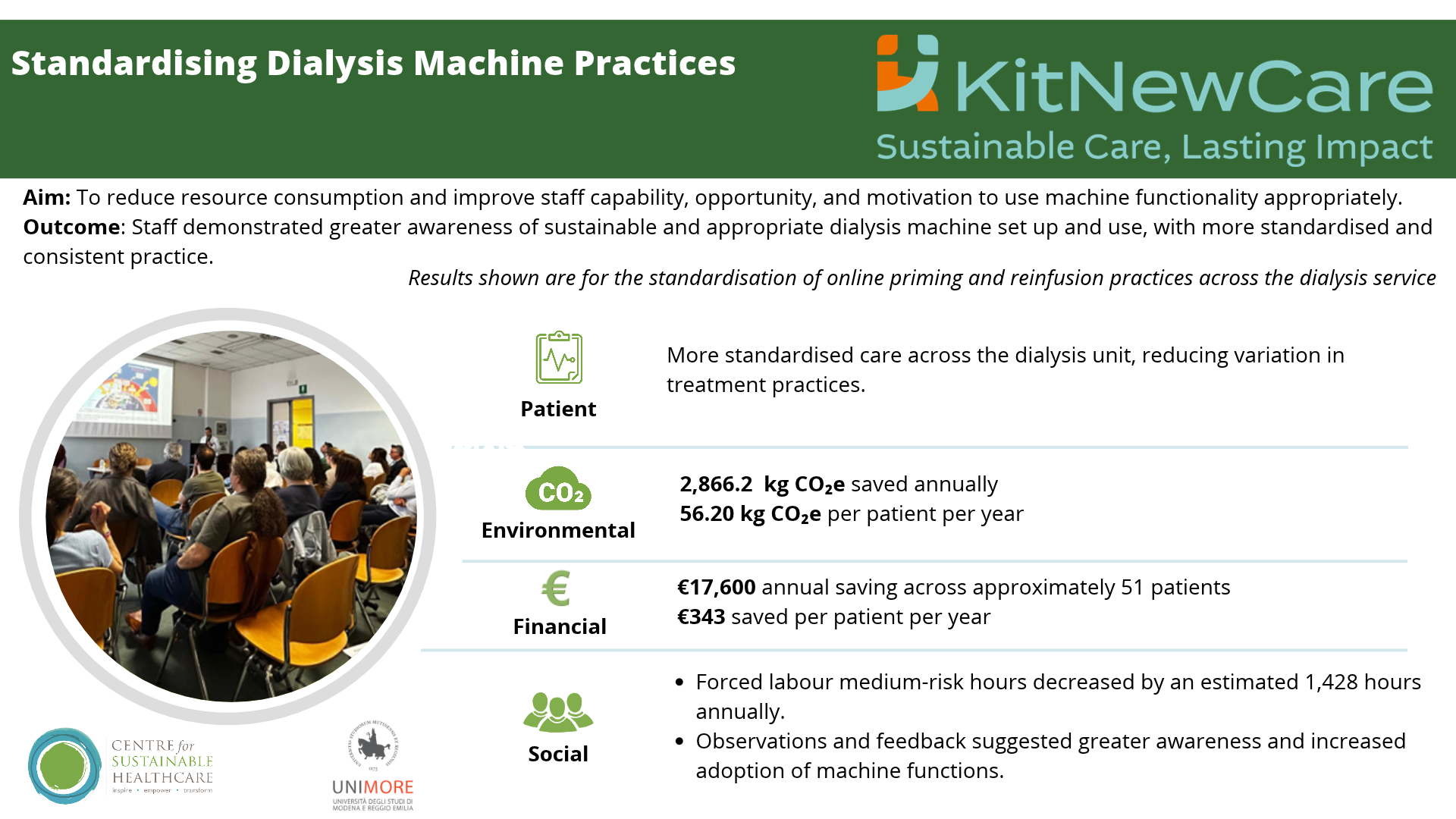
Standardising the use of online priming and reinfusion eliminated the need for saline bags and associated giving sets in approximately 8,000 haemodialysis treatments annually (20% of treatments). This resulted in an estimated reduction of 2,866 kg CO₂e per year, equivalent to approximately 56 kg CO₂e per patient per year.
Economic
Replacement of saline-based priming and reinfusion with online priming and reinfusion was estimated to save €17,600 annually through reduced consumable use. This equates to approximately €343 per patient per year. Savings were estimated using indicative European costs for saline bags and associated giving sets.
Social
The change was associated with an estimated reduction of 1,428 medium-risk forced labour hours annually (approximately 28 hours per patient per year). Staff engagement activities also increased awareness of variation in practice and supported greater standardisation in the use of dialysis machine functions across the service.
Summary
This project demonstrated that standardising dialysis practices through a combination of technical guidance and behavioural approaches can improve consistency in machine use and reduce unnecessary resource consumption. At the time of reporting, quantified sustainability benefits were available only for the increased use of online priming and reinfusion, additional benefits from other standardisation activities were not measured. Involvement of nursing staff in the planning and implementation of the intervention was critical to its success.
 Download resource -
Please log in or sign up to comment.