
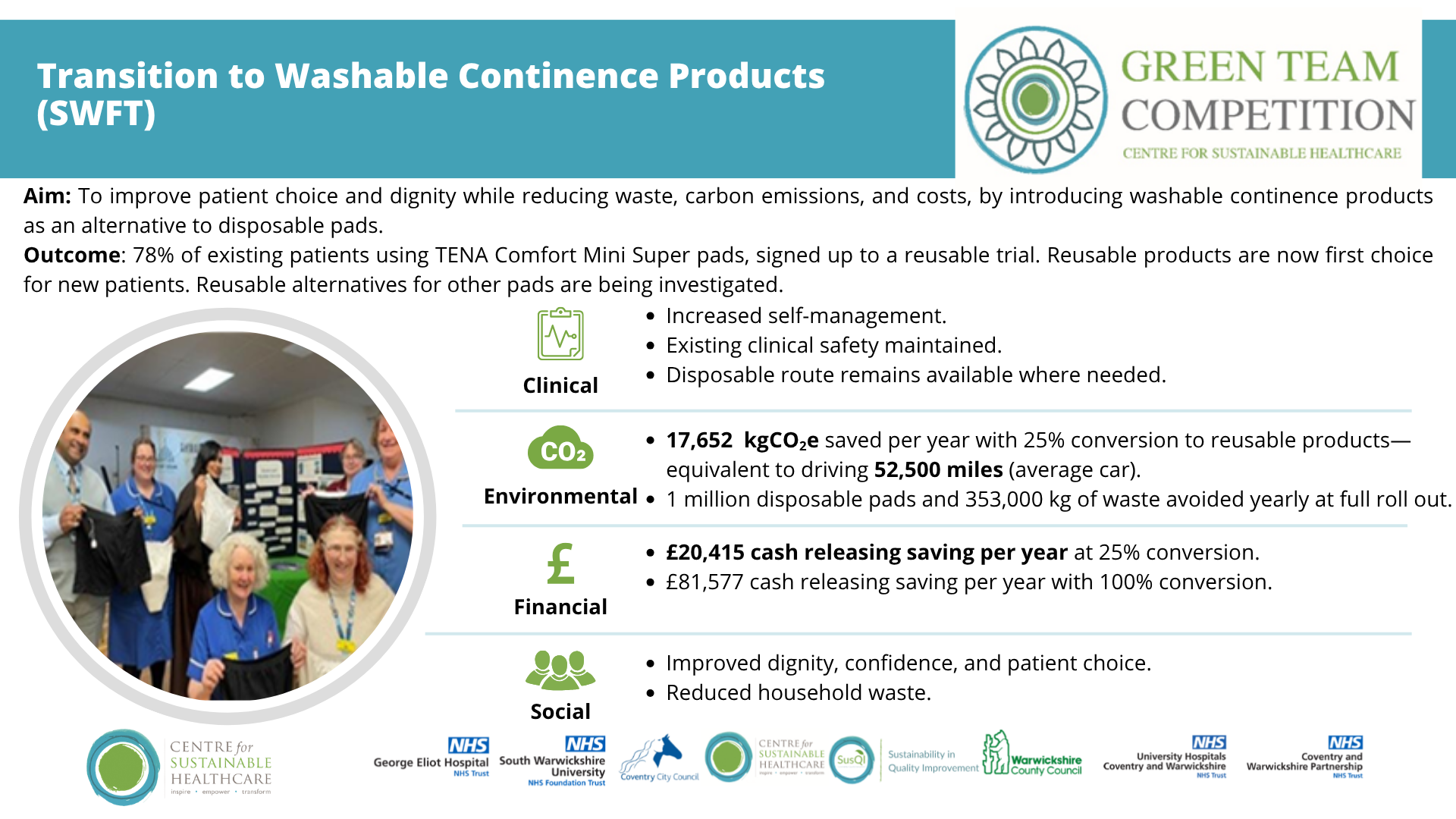
This project was completed as part of the Coventry and Warwickshire ICB Green Team Competition.
Team members
Jo Chapman, Clinical Lead.
Louise Smith, Bladder and Bowel Specialist Nurse.
Abdul Ghafoor, Project Manager.
Sallie Green, Operational Lead.
Setting / patent group:
Patients living at home within the South Warwickshire University NHS Foundation Trust (SWFT) Bladder and Bowel Service, who are prescribed disposable continence products.
Issue:
The continued use of disposable continence pads created a high-volume, plastic-rich waste stream, generating significant carbon emissions, repeated deliveries, and ongoing costs. The existing pathway also limited patient awareness of washable alternatives that could offer greater dignity, independence, and a more sustainable approach to continence care
Intervention:
Washable continence underwear was introduced as a first-choice option for clinically suitable patients within the continence service. The redesigned pathway included patient engagement events, product demonstrations, clinical assessment, personalised fitting, education on use and laundering, and structured follow-up reviews, ensuring a safe, supported, and patient-centred transition from disposable products where appropriate.
Outcomes:
Clinical
The introduction of washable continence products increased patient choice, dignity, and self-management while maintaining clinical safety. Patients received a supported alternative pathway with assessment, fitting, follow-up reviews, and the option to return to disposable products if required
Environmental
A 25% reusable uptake rate will save 17,652 kgCO₂e per year, with 100% roll out having the potential to save 70,608 kgCO₂e per year. By replacing disposable products with reusable alternatives, it could avoid the use of more than 1 million disposable pads each year and reduce waste by approximately 353 tonnes annually.
Financial
The reusable continence pathway is projected to generate recurrent yearly cash releasing savings of £20,415.64, increasing to £81,577 with 100% roll out. This equates to a saving of £85.78 per patient per year converted to washable products.
Social
The project promotes dignity, confidence, independence, and patient empowerment by providing a normal-looking continence product and greater choice. Engagement was strong, with 77.8% of attendees at patient events signing up to trial washable products, demonstrating high levels of interest and acceptance. The intervention also reduces household waste and supports a more sustainable approach to continence care.
Key learning point
Sustainable product substitution can improve patient experience while reducing waste, carbon emissions, and costs. Early patient involvement, clear communication, and maintaining choice were critical to success.
Please log in or sign up to comment.